Why Sign the Statement?
A Call for a Global Standard for Open Heritage Backed by Expertise

Aruba became the first country in the world to sign the international Open Heritage Statement at the government level. Prime Minister Mike Eman signed the document in The Hague, in the presence of Brigitte Vézina, Director of Policy at Creative Commons, Cultural Ambassador of Aruba Michael Lampe, and Minister Plenipotentiary of Aruba Mildred Schwengle. Photo by Biblioteca Nacional Aruba 2026 is licensed under CC BY 4.0.
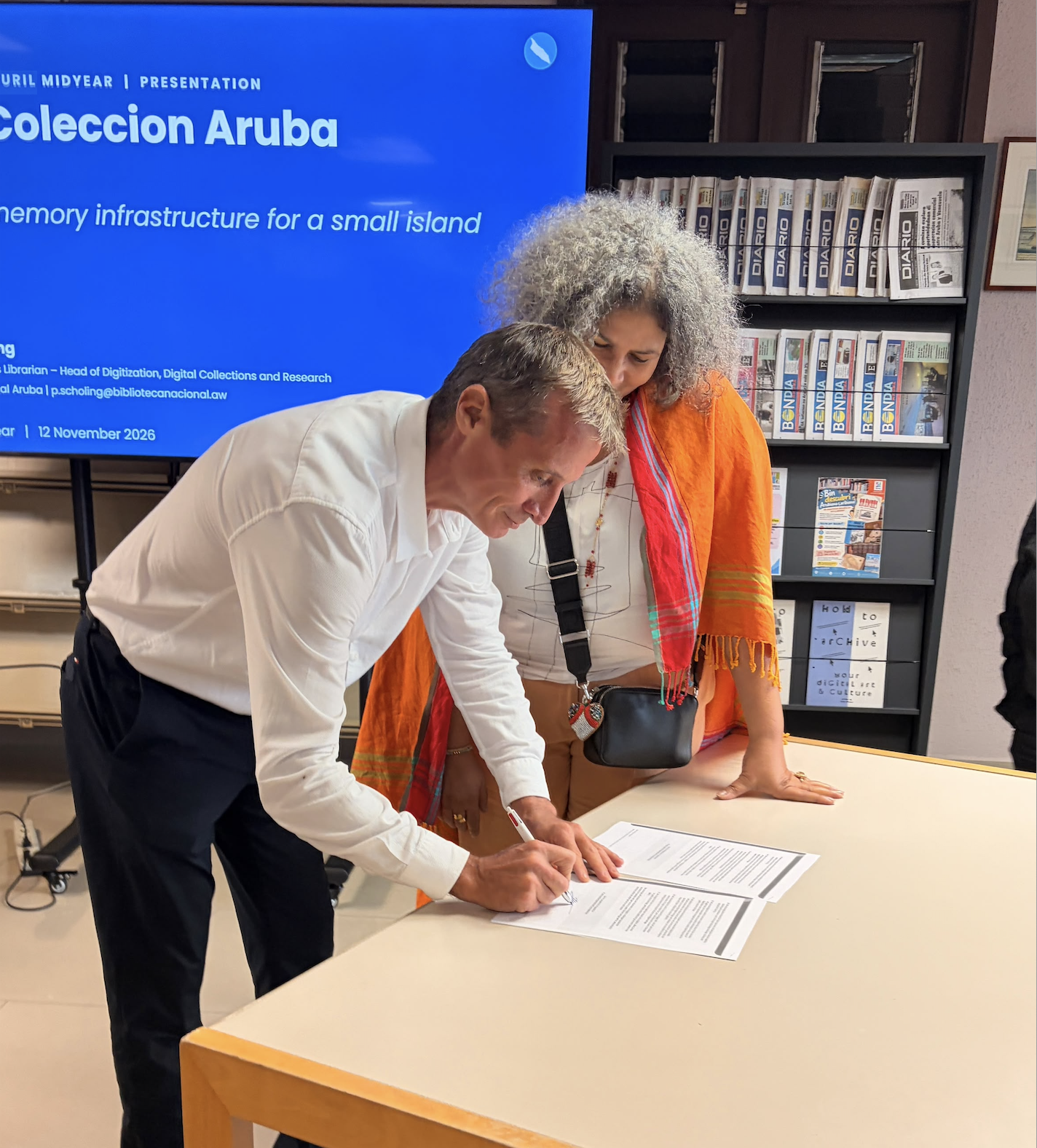
The Association of Caribbean University, Research and Institutional Libraries (ACURIL) signs The Open Heritage Statement. Photo by Biblioteca Nacional Aruba 2026 is licensed under CC BY 4.0.
Pictured Sylvain Houdebert, ACURIL President, and Elizabeth Pierre-Louis. ACURIL Executive Secretary.
Benefits of Access
To understand our present, we need to know our past: our memories, our history, our heritage. When heritage is open, equitably accessible, and reusable, it sparks new narratives across diverse contexts, nurtures collective memory, advances digital equity, and invites people to transform yesterday’s heritage into today’s creativity and tomorrow’s innovation. Access to heritage is vital for cultural participation, creativity, and sustainable development.
Barriers to Access
Over the last two decades, digital access has expanded, but unfair and unnecessary legal, technical, economic, and social barriers still limit public engagement with heritage in the public domain.
From wrongful copyright claims and technological locks to prohibitive fees, these obstacles prevent people from meaningfully connecting with their own history, leaving critical pieces of our shared culture out of reach.
These barriers weaken the foundations of cultural participation, digital inclusion, and open knowledge societies that support the achievement of UN Sustainable Development Goals.
Open Solutions to Remove Barriers
We know that open solutions can help remove such barriers and enable everyone to tell the stories of our shared humanity. The benefits of open heritage show what becomes possible when barriers are removed and heritage in the public domain is openly accessible. From advancing cultural rights and digital equity to fueling education and scientific research and discovery, open heritage generates ripple effects across society. And as the world faces multiple challenges, open heritage is all the more critical if we want to sustain resilient, free and democratic societies, strengthen fundamental freedoms, and foster the production of new solutions to the world’s biggest problems.
Open heritage can prompt curiosity, unlock creativity, spark imagination, spur artistic experimentation, and nurture the contemporary art scene. It allows artists, creators, designers, and creative entrepreneurs to have a fresh take on our shared heritage. Open heritage is essential if we want people to be able to interrogate humanity’s cultural record, participate in cultural life, and enjoy the arts without barriers and on equitable terms.
Why a UNESCO Recommendation?
Yet without global alignment, the full potential of open heritage remains out of reach and many cultural heritage institutions remain ill-equipped to provide equitable access. An international standard could unlock that potential by giving cultural heritage institutions a shared framework, mobilizing resources, and enabling collaboration worldwide for more equitable access to heritage.
UNESCO is uniquely positioned to provide this alignment through a standard-setting instrument. Its Recommendations establish shared principles that Member States adapt into national laws, creating consistency and clarity across borders. This approach has proven successful:
Documentary Heritage (2015): Strengthened preservation and access policies, including for digital archives, through the Memory of the World program.
Open Educational Resources (2019): Stimulated the adoption of national OER policies, the building of public access repositories, and funding mechanisms.
Open Science (2021): Sparked regional action plans, new tools for open data, and a global monitoring framework already reshaping how science is shared.
A UNESCO Recommendation, or other standard-setting instrument, on open heritage in the public domain could establish shared principles for access, guide cultural heritage institutions, give Member States common standards, and enable cross-border collaboration to enable everyone to tell the stories of our shared humanity.